
Three Blood Tests I Recommend for Most of My Patients

Three tests tell me more about a patient's long-term health than almost anything else on a standard lab order: hemoglobin A1c, apolipoprotein B, and lipoprotein(a).
I run all three on nearly every new patient in myconcierge internal medicine practice in Beverly Hills. Not because they are exotic, and not because more testing is automatically better. I run them because conventional annual bloodwork is built to answer a different question. It tells you whether something is wrong today. These three speak to where you are headed.
What a Standard Panel Does Not Tell You
Most annual physicals include a complete blood count, a metabolic panel, and a standard lipid panel. Those are useful tests and I order them too. They were simply never designed to characterize risk over decades.
Two gaps stand out. A fasting glucose captures one morning, which may or may not represent the other three hundred and sixty four. And a standard lipid panel measures how much cholesterol is being carried, not how many particles are carrying it. Those are different questions, and the second one is closer to the biology of arterial disease.
The point is not to order more tests. It is to order better ones. Three well-chosen markers give you more usable information than twenty poorly chosen ones, and advanced biomarker testing is only worth doing when each number changes something about the plan.
1. Hemoglobin A1c
What it measures. Glucose in the bloodstream binds to hemoglobin, and that binding is permanent for the life of the red blood cell. Because red cells circulate for roughly one hundred twenty days, A1c reflects average blood sugar over about three months. It is reported as a percentage.
How it is interpreted. The conventional bands are below 5.7 percent, 5.7 to 6.4 percent, and 6.5 percent or higher. Those thresholds matter for diagnosis. They are not, in my view, where the interesting information lives.
The interesting information is the trend. A patient who moved from 5.2 to 5.6 over three years has a lab report that says normal every single year. Nothing on the page flags it. But the direction of travel is real, and it is far easier to change course at 5.6 than at 6.5. Watching the slope rather than the cutoff is one of the practical advantages of seeing the same patient over time with the same labs in front of you.
Where it can mislead. A1c is not infallible. Anemia, hemoglobin variants, recent blood loss, pregnancy, and chronic kidney disease can all shift the number independently of actual glucose control. This is why I read A1c alongside fasting glucose and fasting insulin rather than in isolation. In my practice, a single A1c almost never drives a decision on its own.
Why it belongs on the list. Insulin resistance sits upstream of a great deal of what shortens healthspan, including cardiovascular disease and cognitive decline. A1c is the least expensive window into that process, and it tends to move before symptoms do. It also pairs naturally with body composition analysis, since visceral fat and metabolic function track together closely.
2. Apolipoprotein B
What it measures. Every atherogenic lipoprotein particle carries exactly one apolipoprotein B molecule. One particle, one apoB. Measuring apoB therefore counts the particles rather than estimating the cholesterol riding inside them.
Why particle count matters. Atherosclerosis is a particle problem. Plaque forms when lipoprotein particles cross the arterial wall and lodge there. The number of particles delivered to that wall is what drives the process, and cholesterol content is only a rough proxy for it.
This distinction is not academic. Two people can have an identical LDL cholesterol and meaningfully different particle counts, because particles vary in how much cholesterol each one carries. When someone's particles are small and cholesterol-poor, it takes more of them to produce the same LDL-C. The lipid panel looks reassuring. The arterial exposure is not.
Clinicians call this discordance, and it is most common in exactly the patients who most need to know about it: those with insulin resistance, elevated triglycerides, or metabolic syndrome. Which is to say, the patients most likely to be told their cholesterol is fine.
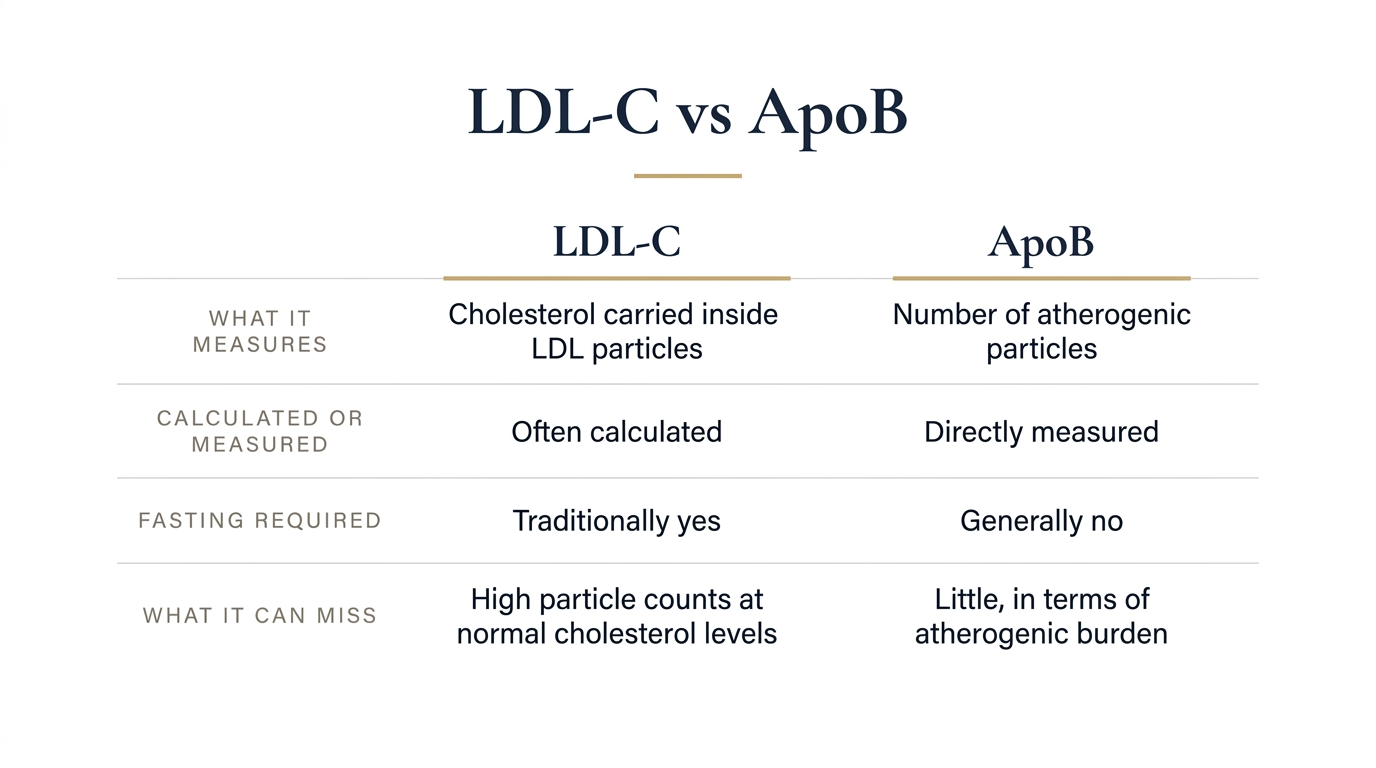
TheNational Lipid Association's 2024 expert clinical consensus on apoB reached a similar conclusion, noting that when LDL-C and apoB disagree, risk generally tracks with apoB.
Practical notes. ApoB does not usually require fasting, which makes it easy to add to a draw a patient is already having. Target ranges are individualized rather than universal. Lower is generally better, and how much lower depends on the rest of the risk picture, including blood pressure, family history, and the two other tests on this list.
In my practice. ApoB is the number I look at when a standard lipid panel reads unremarkable and the rest of the clinical picture does not agree with it. More often than patients expect, that is where the explanation is.
3. Lipoprotein(a)
What it is. Lipoprotein(a) is an LDL-like particle with an additional protein, apolipoprotein(a), attached to it. It is atherogenic, and it behaves differently enough from ordinary LDL that it needs its own measurement.
The genetic point. Lp(a) levels are largely inherited. They are set early, remain relatively stable across adult life, and move very little with diet, exercise, or the lifestyle changes that shift most other lipid markers. That has one convenient consequence: for most people, this is a once-in-a-lifetime test.
Roughly one in five people carries an elevated level. Most of them have never been tested for it.
What elevation is associated with. Elevated Lp(a) is independently associated with atherosclerotic cardiovascular disease and with aortic valve stenosis, and the association holds across sexes and ethnic groups. The 2022 European Atherosclerosis Society consensus statement covers the evidence in detail and notes that elevated Lp(a) carries risk even when LDL cholesterol is well controlled.
If I cannot change it, why measure it? This is the first question patients ask, and it deserves a direct answer. Three reasons.
It changes how aggressively everything modifiable gets managed. An elevated Lp(a) is a reason to be more attentive about apoB, blood pressure, and metabolic health, not less.
It is a family finding. An elevated result is a reason for parents, siblings, and children to be tested.
Targeted Lp(a)-lowering therapies are in late-stage clinical development. Knowing your number now means you are positioned for that conversation when the data arrives, rather than starting from scratch.
In my practice. I order Lp(a) once, early, on nearly every adult panel. It is inexpensive, it never needs repeating, and it reframes how I read everything else. It fits the same logic behind the rest of the longevity-focused diagnostics I use: measure the things that change decisions.
Reading All Three Together
Each of these tests answers a different question, and the value comes from reading them as a set.
A1c describes the metabolic environment your cardiovascular system is operating in.
ApoB describes the current burden being delivered to your arterial wall.
Lp(a) describes the inherited baseline sitting underneath both.
Any one of them alone is a partial picture. A normal A1c with a high apoB is a different patient than a high A1c with a normal apoB, and both are different again once you know the Lp(a). Together they cover environment, exposure, and genetics.
I will say the same thing here that I say about full-body imaging. The test is the easy part. What matters is having a physician who knows your history read the result in context and decide what, if anything, should change. A number without interpretation is data. It is not care.
Common Questions
How often should these tests be repeated? A1c and apoB are reasonable to check annually, or more often when something is actively being managed. Lp(a) is generally a one-time test, since levels are genetically determined and stable across adult life.
Is apoB the same as LDL cholesterol? No. LDL-C measures the cholesterol carried inside LDL particles. ApoB counts the atherogenic particles themselves. They usually move together, and when they do not, apoB is the more informative of the two.
Do I need to fast for these tests? A1c and Lp(a) do not require fasting. ApoB generally does not either, though your physician may ask you to fast if other markers are being drawn at the same time.
Will insurance cover apoB or Lp(a) testing? Coverage varies by plan and by the clinical indication documented. Both are relatively inexpensive tests when paid directly, which is worth knowing before you assume they are out of reach.
What is considered a high Lp(a)? Thresholds vary by laboratory and by whether results are reported in mg/dL or nmol/L, which is one reason the result should be interpreted by a physician rather than read off the page. Elevated levels are common, and elevation is one input into overall risk rather than a diagnosis on its own.
Three tests. Two of them worth repeating each year, one you never have to think about again. Between them, they describe your metabolic and cardiovascular trajectory rather than your status on a single morning.
Most of what they reveal is actionable. And the earlier the picture is clear, the more room there is to change it.
Justin Donlan, MD, is board-certified by the American Board of Internal Medicine and practices concierge internal medicine and longevity medicine in Beverly Hills, California. This article is for general educational purposes and is not a substitute for individualized medical advice.
